Vicenza Jewelry Museum: The Art of Italian Goldsmithing
Paola Venturelli, curator of the Vicenza Jewelry Museum, discusses the biennial exhibition at the Basilica Palladiana and the close connection between jewelry making and Italian art
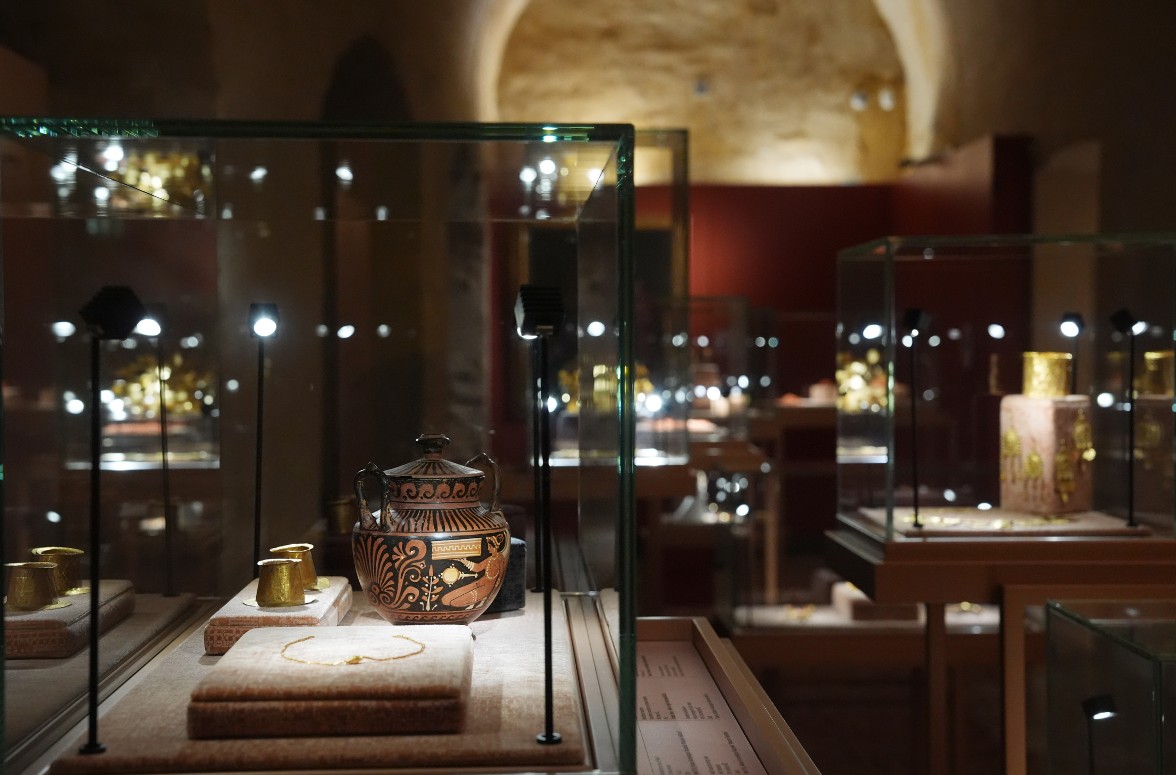
Six rooms on the first floor of the Basilica Palladiana are home to the Vicenza Jewelry Museum (Museo del Gioiello di Vicenza). Until 2027, visitors can explore "Gioiello – Italia" (Jewelry – Italy): the biennial exhibition inaugurated in 2025 that spans twenty-five centuries of Italian goldsmithing to tell the story of an art form long considered "minor." We spoke about it with the curator, Paola Venturelli, Conservator of the Museum and guest at Vicenzaoro September 2026—the leading international event for the gold and jewelry sector organized by Italian Exhibition Group.
This biennial exhibition is titled "Gioiello – Italia." What role does the world of precious objects play in the history of Italian artistic heritage?
Jewelry plays an enormous role in Italian art history, even though it receives little attention and is defined as a minor art. First and foremost, jewelry is part of our tradition and the history of the Italian peninsula: indeed, great artistic figures have engaged with goldsmithing. Consider, for example, Benvenuto Cellini, who was a goldsmith as well as a sculptor.
Why was goldsmithing historically defined as a minor art?
In reality, until the seventeenth century—and in some ways even beyond—there was no such distinction between major and minor arts. Many artists in previous centuries actually had training as goldsmiths. It was during the seventeenth century that the concept of the universal artist began to decline: the mechanical arts were progressively diminished and deemed inferior. Moving into the nineteenth century, the divide between minor and major arts became very rigid, and goldsmithing assumed a completely subordinate role compared to painting, sculpture, and architecture, which were considered more noble.
Why did this devaluation occur?
There was a shift in theoretical thinking: mechanical arts came to be seen as "vile" arts—manual labor using tools, and therefore placed on a lower level. Noble arts were the arts of the mind: philosophy, writing. Even painting struggled for a time to find its standing, but eventually regained prestige, whereas goldsmithing remained confined to the domain of the minor arts. The definition itself is telling: while it disappeared abroad long ago, it still persists in Italy—if we consider that "history of minor arts" is still taught in universities today.
Yet simply entering the Jewelry Museum is enough to realize that fine jewelry represents a very high form of art.
Exactly. After World War II, a desire for the rebirth of goldsmithing emerged. The "Gioiello – Italia" exhibition devotes an entire section to this turning point in how jewelry was understood, driven by a group of artists, painters, sculptors, and goldsmiths determined to refocus attention on jewelry as a fully-fledged work of art with its own interpretive categories.
Thus, in the second half of the century, "designer jewelry" (gioiello d'autore) and "artist jewelry" (gioiello d'artista) were born: think of Pablo Picasso, Marcel Duchamp, and in Italy, Fausto Melotti, Bruno Martinazzi, and Aligi Sassi—great sculptors and painters who also embraced goldsmithing during their careers.
The link between major and minor arts is actually very subtle. In the exhibition layout—organized by materials, from gold to coral, ancient glass to micromosaic, pearls, and gemstones—this tension between craft and art runs through every room. You find it in the Etruscan granulation of ancient jewelry, in the cameo market in Rome between the 19th and early 20th centuries reinterpreting archaeology in the jewelry of the Castellani family, all the way to Art Deco and the Italian abstractionism of 1960s coral work.
The final room of the museum, dedicated to goldsmithing icons, fully captures this connection between jewelry and art. The bracelet by Gianmaria Buccellati is a prime example.
That bracelet is an extraordinary work, and I specifically wanted it in the final room—the Icons section—where three emblematic goldsmithing figures coexist: Edgardo Mannucci, a sculptor working in Informalist art; Mario Pinton, founder of the Padua school, a theorist, almost a mathematician of goldsmithing; and Gianmaria Buccellati, who had an entrepreneurial approach capable of expanding the maison not only to America but also to the East, without ever compromising on tradition.
That cuff bracelet represents the evolution of pierceless openwork (traforo) that his father, Mario, had started in the 1920s: taking a sheet of metal and piercing it until it almost turns into lace. Gianmaria introduced an exceptional flexibility into the piece through a meticulous study of hidden hinges and mechanisms.









Follow us on social networks
Subscribe to the newsletter